
Sunday, November 6, 2011
I like my tea...pungent?


John, Paul, George and Ringo

Nowhere Man! Yellow Submarine! Lucy in the Sky With Diamonds! Hard Day's Night! Help!
These guys (pictured above) played all of those songs and more in five sets over four and a half hours at Abbey Road, a nightclub in Roppongi near Midtown, and they were amazing, just spot-on. The guy doing John, with his frizzy mad-scientist hair and dark specs, was absolutely brilliant, knocking it outta the park with "Happiness is a Warm Gun" and "While My Guitar Gently Weeps." A baby-faced George - offstage nickname, "Bambino" - smiled a lot, charming the pants off us girls. Paul looked like a regular Japanese salaryman, but his "Let It Be" gave me chills. Ringo wasn't Ringo, but who could be?
The space isn't anything to get excited about -- we spent the evening seated with our friends around a small wooden table inches away from the next, ordering drinks and food, and forbidden to dance. You could sway a little, and clap of course -- and hold our heads and weep like those crazy fans from the early days, if we wanted to -- but how unsatisfying, especially when you hear the opening bars of yet another favorite. You wanna jump up! That's what you'd do if you were at a concert. This is more like dinner theater, with pitchers and good nachos (albeit a dainty, delicately arranged plate of them). I recommend the fish and chips.
An unexpected plus: usually when we go out at night in Tokyo, even though I don't smoke, my hair ends up smelling like an ashtray, but at Abbey Road, there's no smoking allowed while the band is playing - maybe to protect their vocal cords from the evil second-hand fumes? Whatever the reason, it works for me. No ashtray hair.
I suspect that the Parrots know every Beatles track ever recorded -- they perform at Abbey Road nearly every night of the week - and they do take requests. But no shouting out - you need to fill out a form and hand it to the waitress. The band didn't play many of the songs we asked for though. Not like the band we saw a couple times awhile back at the Cavern Club. Those guys played every tune on our list. (Helter Skelter! Glass Onion!) And like the Parrots, those guys were solid performers, all Beatles. They were also true impersonators, making more of an effort to mimic the personal styles and stage mannerisms of the original Fab Four. They even donned authentic band uniforms from Sgt. Pepper's the night they covered that album from beginning to end. (Lovely Rita! For the Benefit of Mr. Kite!) But the Cavern Club seems to have closed, or changed its theme, leaving Abbey Road to carry on solo. Or so it would seem. If anybody knows of another Tokyo hotspot of Beatlemania, please, share. In any case, Abbey Road will do just fine.
Abbey Road
Roppongi Building Annex B1
4-11-5, Roppongi, Minato-ku, Tokyo 106-0032
information@abbeyroad.ne.jp
Tel 03 3402 0017
Cost is 2,100 per person, plus two-drink minimum and 15% service charge. The latest reservation you can make on Fridays and Saturdays is 7:30pm; we booked for 7pm on Saturday, and by the time the band came on at 7:30pm, the place was full. There were some empty tables during the last set, which ended shortly after midnight.

Friday, November 4, 2011
Omotesando Koffee

This fantastic spot is almost too good to share. It's a tiny space, inside a traditional Japanese house down a side street in Jingumae north of Omotesando dori, with a lovely little outdoor garden seating area. I had the cappuccino, and a bit of baked custard, the sole food item available (trust me, it's all you need). Many thanks to Katy Dix (above) for introducing me. KT had seen this writeup about it in the FT, which, I should point out, calls the shop a "pop-up" that will change locations in January, but the owner told us today that it was staying put for now.
The cube of carmelized sugar (yummmm)

The interior is charming with its chandelier of paper notes and scribblings

Directions by bike or on foot: Head west (more like west-northwest) along the north side of Omotesando dori away from the Aoyama dori intersection and turn right after the United Colours of Benetton. Go to the end and follow the road as it curves to the left. When you reach "Yellow Ruby" at the next corner, turn right and head straight down that road another 2 short blocks or so and Omotesando Koffee will be on your left hand side, directly across from a vacant lot that's thick with weeds as high as your neck.
Omotesando Koffee
Address: 4-15-3 Jingumae, Shibuya-ku 150-0001
Tel: 03 5413 9422
Open 10 am to 7 pm
Thursday, November 3, 2011
Toulouse-Lautrec in Marunouchi!


A copy of one of T-L's most famous portraits, that of cabaret singer Aristide Bruant, happens to grace a building facade on 18th Street in Adams Morgan, in Washington DC. The Toulouse-Lautrec bar that occupied that building is no longer there -- the space has apparently been vacant for some time -- but the mural remains. Even though my friends and I, I won't say how many years ago, favored Millie & Al's across the street (cheapest pitcher of beer in town, but how did we eat that awful pizza??), Toulouse-Lautrec will always make me think of college.

but I'm not embarrassed...
With apologies to any male readers, when a lady purchases anything categorized as a 'feminine hygiene' product here, store clerks typically wrap it in brown paper, or a separate opaque bag. Yesterday, Lawson's did me one better with a girlie polka-dot number. (My light bulbs, blank DVDs and rice crackers were placed inside a standard-issue white bag. Shut up, I forgot my eco-bags at home.)

So why the fuss? Am I supposed to be ashamed of my pantyliners?
Silly and unnecessary and old-fashioned as it seems, I shouldn't be surprised. There are particular ways of doing things here. There are standards to uphold. It wouldn't hurt us women to cultivate a bit of mystery now and then. There may be oversharing on Facebook and YouTube, but goshdarnit our unmentionables will remain hidden from view!
It does make sense given Japan's reputation for above-and-beyond customer service. The country ranked No. 1 on that score in a recent poll of 400 international travelers, reported in the Aug. 5, 2011, issue of the New York Times Magazine. Russia came in dead last out of 24 nations; also at the bottom of the heap were China and Mexico. U.S. took 7th place, England, 16th. They're not special-wrapping the maxipads over there, now, are they?

So why the fuss? Am I supposed to be ashamed of my pantyliners?
Silly and unnecessary and old-fashioned as it seems, I shouldn't be surprised. There are particular ways of doing things here. There are standards to uphold. It wouldn't hurt us women to cultivate a bit of mystery now and then. There may be oversharing on Facebook and YouTube, but goshdarnit our unmentionables will remain hidden from view!
It does make sense given Japan's reputation for above-and-beyond customer service. The country ranked No. 1 on that score in a recent poll of 400 international travelers, reported in the Aug. 5, 2011, issue of the New York Times Magazine. Russia came in dead last out of 24 nations; also at the bottom of the heap were China and Mexico. U.S. took 7th place, England, 16th. They're not special-wrapping the maxipads over there, now, are they?
Tuesday, November 1, 2011
such workaholics
We spent Day 3 of the boys' half-term holiday at KidZania, this insane place where children can pretend to be cooks, cops, barbers, surgeons, airline pilots, firefighters, manga artists, pizza chefs, photographers, even Coca-Cola bottlers. Grownups, mercifully, are not admitted into the various work/role-playing areas, which are all incredibly well-staffed. The moms did help the kids navigate the place a little, and did a fair amount of nudging when they seemed indecisive or otherwise at loose ends, but mainly we sat around talking and drinking coffee and occasionally taking pictures. The place is headache-inducing, with the cacophonous acoustics and dim lighting (as in most casinos, it's always dusk in Kidzania-land) but the boys absolutely loved it, and I can think of worse ways to occupy them for a day (like Tokyo Disney, with its endless lines - ugh).
Interestingly, KidZania started in Mexico City in 1999; the Tokyo franchise opened in 2006. There are KidZanias in Jakarta, Lisbon, Dubai and Seoul, and supposedly there will be KidZanias in the U.S. come 2013. Not sure if they all operate the same way, but the KidZania here is all about waiting in line, undergoing a thorough briefing of rules and procedures, donning uniforms (surgical caps are required under any headgear), etc. There's a lot of preparation before there's any action. And yet the kids don't seem to mind. In six hours, they managed to complete seven jobs.
Conor's dance card, nearly full:

Dylan, the cop

Conor, the cook

Conor, the barber
 Lots of school groups were there that day

Interestingly, KidZania started in Mexico City in 1999; the Tokyo franchise opened in 2006. There are KidZanias in Jakarta, Lisbon, Dubai and Seoul, and supposedly there will be KidZanias in the U.S. come 2013. Not sure if they all operate the same way, but the KidZania here is all about waiting in line, undergoing a thorough briefing of rules and procedures, donning uniforms (surgical caps are required under any headgear), etc. There's a lot of preparation before there's any action. And yet the kids don't seem to mind. In six hours, they managed to complete seven jobs.
Conor's dance card, nearly full:

Dylan, the cop

Conor, the cook

Conor, the barber


Saturday, October 22, 2011
return to Ghibli
The boys have been off school this past week, and with no family travel plans, we've been hitting our favorite spots in and around Tokyo. On the Monday, it was the Ghibli Museum in Mitaka. We've been to this place -- a wonderful homage to Hayao Miyazaki and his studio's animated works -- before, but that was a couple years ago, so it was nice to return for another view of the robot on the roof (a soldier from "Laputo: Castle in the Sky," see pic below). The kids were also happy to climb on the beloved cat bus (after queuing and being briefed by staff on the rules, of course), and throw plush soot sprites at each other. And who can ever get tired of looking at the zoetrope (spinning figures illuminated by strobe light as to appear animated) featuring characters from My Neighbor Totoro.
It's easy to combine a visit to Ghibli with a day out in Kichijoji. We took the Keio Inokashira express train from Shibuya so it took no time at all -- maybe 20 minutes -- and walked down Nanaibashi shopping street, a pleasant pedestrian friendly corridor, though we did not stop in any of the cute shops or cafes but instead bounded straight into Inokashira park.
 Immediately, a sign to guide us
 Get that chin up over that bar! Many thanks to Russell (straw hat) for getting us the Ghibli tickets. You have to buy them in advance, which you can do at any Lawson's convenient store; you're only admitted at your appointed time -- ours was 2pm -- but can stay until closing; the cost is 1000 yen for an adult, 400 yen per child. For more ticket info, click here.
 The first thing you see when you reach the museum from the park side is a giant Totoro in a glass booth.
 You have to climb a spiral staircase to reach the roof. A little girl we didn't know watched my friend's kid climb while my 9-year-old posed next to another fellow museum visitor whose boyfriend probably figured, might as well take it, these kids are never gonna get out of the picture!
 Taking photographs is prohibited indoors, so it's amazing I was able to snap a sharp one, seeing as it was done on the sly, and with an iPhone, no less. (See Russell's cat bus pic, below, marred by haste and bad lighting. Sorry, R!)
 This here cat bus -- a second one, big enough for adults to lounge in (no soot sprites to throw around, though) is part of a special exhibit going on right now. Read more about that on the museum's own website.
All in all a grand day out.
It's easy to combine a visit to Ghibli with a day out in Kichijoji. We took the Keio Inokashira express train from Shibuya so it took no time at all -- maybe 20 minutes -- and walked down Nanaibashi shopping street, a pleasant pedestrian friendly corridor, though we did not stop in any of the cute shops or cafes but instead bounded straight into Inokashira park.


All in all a grand day out.
Friday, October 21, 2011
marvelous joe
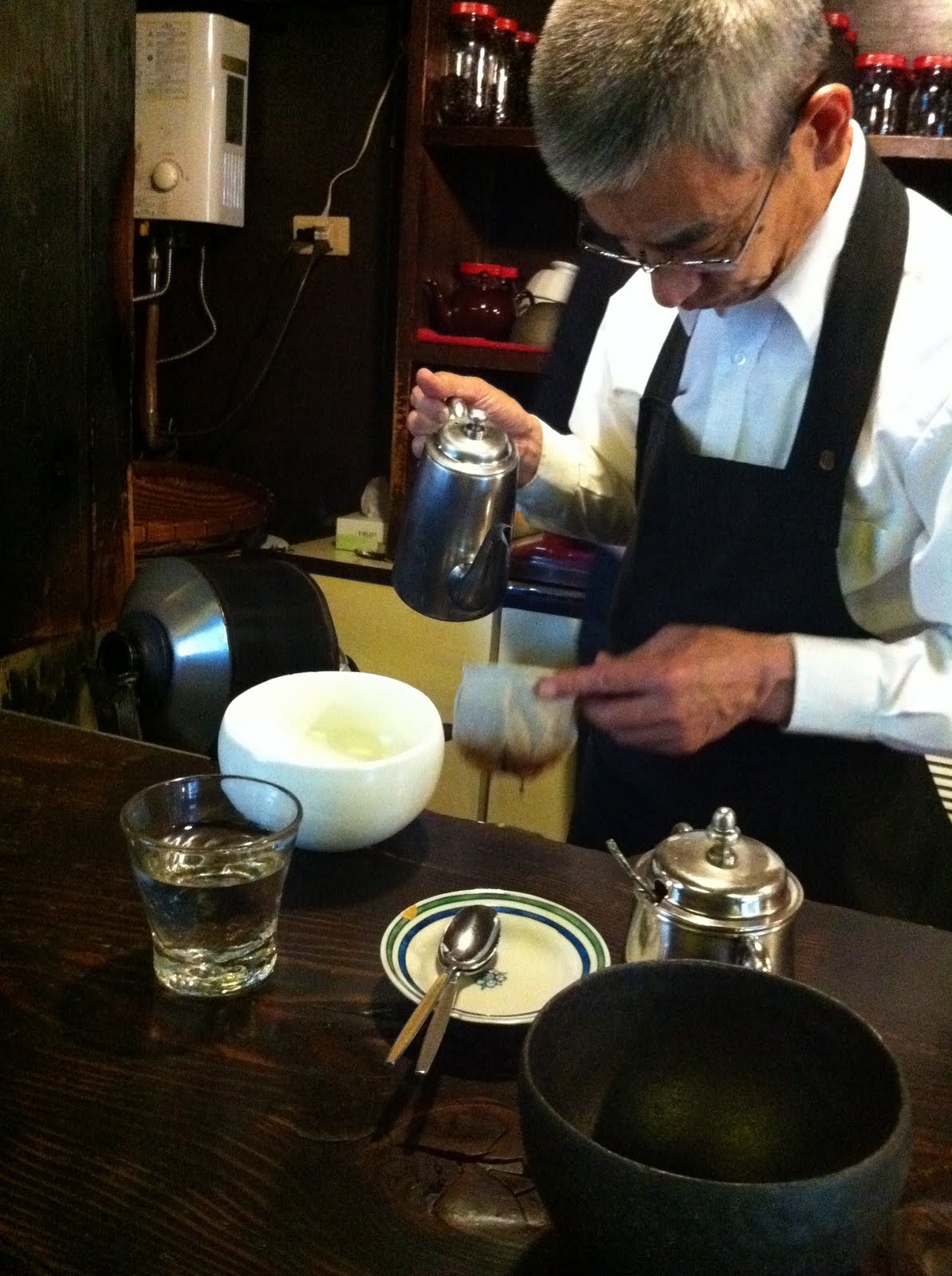
My friend Anna took me to this wonderful little coffee shop on Aoyama dori, in a nondescript building just north of the Omotesando crossing, east side of the street. (I would tell you more precisely how to get there if I could read the address on the meishi.) The man making the coffee (above) is the proprietor, Dai-Bo. A fastidious gentleman, he seemed genuinely pleased to see my friend, who frequents the place and can speak Japanese well enough to maintain lively chitchat with both the kohi master himself and the other customers.
Upon entering I felt like I had been let in on one of the best kept secrets in Japan. There is such a love affair with coffee going on in this joint, such commitment to serving a high-quality cup -- even before we arrived, we caught the smell of beans roasting from the street.
The coffee was served in charmingly mismatched ceramic bowls that reminded me of my visit to Sicily, when my grandmother's cousin served us some really strong Italian brew with lots of hot milk in the same kind of bowl every morning for breakfast.
 If you order the set, you get coffee and dessert. That day it was cheesecake. In typical Japanese fashion, it was only faintly sweet.
There's a long shelf of books that runs the perimeter of the place, just below the ceiling. When we asked about them, Dai-Bo pulled down a hardcover about jazz musicians written by one of his regular customers -- the one and only Haruki Murakami, who, before he achieved world fame as a writer, ran a jazz club in Tokyo. The author's autograph was scribbled on the inside cover (how cool!). Dai-Bo then took out his scrapbook to show us a yellowed copy of a newspaper article about his shop that ran in the New York Times travel section, complete with a photograph of himself, when he was much younger, with a head of thick dark hair.
 Anna, leading me in.
Saturday, October 15, 2011

Wednesday, October 12, 2011
Smile, it's art!
Sculptures by Ugo Rondinone, outside the Yokohama museum of art, now through Nov. 6:


 Altogether, there are 12 heads currently keeping watch outside the museum, part of the Yokohama Triennale 2011 exhibition, "Our Magic Hour: How Much of the World Can We Know?" I went to see this show the other day with three other moms from the British School ("A Spaniard, an American, a Brit and a Norwegian board a train...") and we all thought it was worthwhile, if a bit puzzling in parts (that's ahht, for me at least).
We took the Tokyu-Toyoko line from Shibuya to Minatomirai, a few stops past Yokohama (where you can switch from an express to a local train if you're not already on one) and the museum is a short walk from there. The 12 works that make up Rondinone's "Moonrise" series, according to Art Agenda, were modeled in brown clay, then cast in aluminum and lacquered to match the color of the original material. Their surfaces are finger-stroked, mottled, soft to the touch. We couldn't help but push gently into the surface grooves with our fingertips before noticing the sign saying keep off - oops.
The rest of the show was a bit hit or miss for me. My favorite video work was a short film by Romanian artist Mircea Cantor called "Tracking Happiness," featuring seven women dressed in white, walking barefoot in sand, each silently sweeping away the footprints left by the person in front of them. It's shot from various angles and there's a certain pattern to their movements. We were all a bit mesmerized by it. Apparently it's a commentary on "the creation and revision of history, and the state of information in the computer age." (Audio tours available in English or Japanese.)

We hopped on a free shuttle bus to get to the second venue, BankART Studio NYK, a.k.a. NYK waterfront warehouse, near the Bashamichi metro station (where we later caught our train back to Shibuya -- it's about a half hour's journey).
In one room inside the warehouse you could relax on one of a half dozen upholstered sofas and watch a bit of "The Clock" by Christian Marclay, a 24 hr.-long film comprised of thousands of video clips (it won the Golden Lion prize at the Venice Biennale). Each segment makes some reference, specifically or obliquely, to time - a snatch of dialogue here ("You're late," "It's five to two") a wordless action sequence there (a stressed-out cowboy gets up to go to a window and pull back the curtains). Next there's an Italian family sitting around a table talking and eating dinner, a grandfather clock tick-ticking nearby. And on and on it goes, a continuous string of non-sequiturs culled from a variety of movies and television programs, old and new, obscure and mainstream, dramatic, comedic, in English and other languages. It's a video clock, telling time minute by minute, only the museum can only show the 11 am to 6pm portion (the hours it opens to the public). Glenn Close, in a scene from the 1994 American movie The Paper, looks at her wristwatch and complains about the way her skin "bunches." Spider-Man's boss warns him that if he doesn't deliver those pizzas in 9 minutes, he's out of a job -- cut to a wall clock showing 1:51 pm, and it's 1:51 pm in real life! You get the idea. What an enormous undertaking this must have been, to find all that footage and put it in order, with the timing just right...
Tickets to the Triennale cost 1,600 yen per adult and cover admission to both venues. You need at least 90 minutes at each place if you like to take your time at these sorts of things. You can grab a bite to eat in the cafe at the Yokohama Museum of Art's own cafe (I had the egg salad and tomato sandwich) or take advantage of the many restaurants in the Landmark Tower or nearby Queen's Towers. For 1,000 yen you can ride the superfast elevator up to Landmark's 69th floor "Sky Garden" observatory. Here's the view overlooking the Minato Mirai Shinko district and Cosmo World amusement park, with its giant ferris wheel:

Yokohama Triennale 2011 runs through Sunday, Nov. 6. For information including some useful maps, click here. For more information about that whole area, see Japan-Guide.com


 Altogether, there are 12 heads currently keeping watch outside the museum, part of the Yokohama Triennale 2011 exhibition, "Our Magic Hour: How Much of the World Can We Know?" I went to see this show the other day with three other moms from the British School ("A Spaniard, an American, a Brit and a Norwegian board a train...") and we all thought it was worthwhile, if a bit puzzling in parts (that's ahht, for me at least).
We took the Tokyu-Toyoko line from Shibuya to Minatomirai, a few stops past Yokohama (where you can switch from an express to a local train if you're not already on one) and the museum is a short walk from there. The 12 works that make up Rondinone's "Moonrise" series, according to Art Agenda, were modeled in brown clay, then cast in aluminum and lacquered to match the color of the original material. Their surfaces are finger-stroked, mottled, soft to the touch. We couldn't help but push gently into the surface grooves with our fingertips before noticing the sign saying keep off - oops.
The rest of the show was a bit hit or miss for me. My favorite video work was a short film by Romanian artist Mircea Cantor called "Tracking Happiness," featuring seven women dressed in white, walking barefoot in sand, each silently sweeping away the footprints left by the person in front of them. It's shot from various angles and there's a certain pattern to their movements. We were all a bit mesmerized by it. Apparently it's a commentary on "the creation and revision of history, and the state of information in the computer age." (Audio tours available in English or Japanese.)

We hopped on a free shuttle bus to get to the second venue, BankART Studio NYK, a.k.a. NYK waterfront warehouse, near the Bashamichi metro station (where we later caught our train back to Shibuya -- it's about a half hour's journey).
In one room inside the warehouse you could relax on one of a half dozen upholstered sofas and watch a bit of "The Clock" by Christian Marclay, a 24 hr.-long film comprised of thousands of video clips (it won the Golden Lion prize at the Venice Biennale). Each segment makes some reference, specifically or obliquely, to time - a snatch of dialogue here ("You're late," "It's five to two") a wordless action sequence there (a stressed-out cowboy gets up to go to a window and pull back the curtains). Next there's an Italian family sitting around a table talking and eating dinner, a grandfather clock tick-ticking nearby. And on and on it goes, a continuous string of non-sequiturs culled from a variety of movies and television programs, old and new, obscure and mainstream, dramatic, comedic, in English and other languages. It's a video clock, telling time minute by minute, only the museum can only show the 11 am to 6pm portion (the hours it opens to the public). Glenn Close, in a scene from the 1994 American movie The Paper, looks at her wristwatch and complains about the way her skin "bunches." Spider-Man's boss warns him that if he doesn't deliver those pizzas in 9 minutes, he's out of a job -- cut to a wall clock showing 1:51 pm, and it's 1:51 pm in real life! You get the idea. What an enormous undertaking this must have been, to find all that footage and put it in order, with the timing just right...
Tickets to the Triennale cost 1,600 yen per adult and cover admission to both venues. You need at least 90 minutes at each place if you like to take your time at these sorts of things. You can grab a bite to eat in the cafe at the Yokohama Museum of Art's own cafe (I had the egg salad and tomato sandwich) or take advantage of the many restaurants in the Landmark Tower or nearby Queen's Towers. For 1,000 yen you can ride the superfast elevator up to Landmark's 69th floor "Sky Garden" observatory. Here's the view overlooking the Minato Mirai Shinko district and Cosmo World amusement park, with its giant ferris wheel:

Yokohama Triennale 2011 runs through Sunday, Nov. 6. For information including some useful maps, click here. For more information about that whole area, see Japan-Guide.com
Wednesday, September 28, 2011
the wrath of Typhoon Roke
 outside Shibuya station on Wednesday afternoon, September 21, 2011 (photo by Katy Dix)
Tuesday, September 27, 2011
From Time Out Tokyo
 Posted here on Sept 26, 2011
Sayonara, Center-Gai
Shibuya shopping street undergoes bizarre name change
Click here to the article on the Time Out website.
For decades, it's been a magnet for shoppers, after-work revellers and disaffected youth. But Center-Gai's final weekend of infamy is now behind it. The pedestrianised shopping street, which connects to Shibuya's famed scramble crossing, unveils its new name today – and it sounds more like a children's TV show from the 1970s.
Saturday, September 24, 2011
I needed a shot of those stripey socks
Every so often there's a flea market in a large parking lot down the road from the Meiji Jingu baseball stadium in Kasumigaokamachi, in Shinjuku-ku. You can reserve a spot on the pavement for a couple thousand yen, so a friend of mine booked three spots, and a few of us spent the day selling old clothes, toys, books, random household items and electronics all donated by ourselves and some other friends. We were lucky to be across the aisle from a coffee truck and a few food vendors, and managed to unload heaps of stuff, while practicing the art of bargaining, which I am not good at and which is not usually done here in Japan (it's probably considered poor manners to argue over price). I tend to give in too quickly -- whatever it takes to get rid of that Toy Story puzzle or that large plush mallard duck, I say. But this over eagerness did not always serve me well - when one couple asked how much for the ginormous stuffed lion I practically screeched "200 yen!" and thrust it forward, prompting them to back away, slowly. (My friends at the other stall sold it later for 500 yen - they clearly have the gift.)
So why do we do this? All our proceeds (I think we earned in the neighborhood of 50,000 yen, all told, which ain't too shabby) will go to charity, though we haven't decided on a recipient yet. Last time we did it we gave money to a friend of a friend who was making regular runs up to Tohoku, buying and distributing fresh fruit and veg to those barely scraping by among the wreckage of the March 11 tsunami. Maybe this time it will go to an established NGO like Peace Boat. In any case it was a lot more fun than I thought it would be, and by the end of it we were giving lots of things away for free. These lucky customers (below) looked thrilled to score this plastic Pokemon toy, so in return I asked them to pose for a photo. I think we all know who got the better end of that deal.

So why do we do this? All our proceeds (I think we earned in the neighborhood of 50,000 yen, all told, which ain't too shabby) will go to charity, though we haven't decided on a recipient yet. Last time we did it we gave money to a friend of a friend who was making regular runs up to Tohoku, buying and distributing fresh fruit and veg to those barely scraping by among the wreckage of the March 11 tsunami. Maybe this time it will go to an established NGO like Peace Boat. In any case it was a lot more fun than I thought it would be, and by the end of it we were giving lots of things away for free. These lucky customers (below) looked thrilled to score this plastic Pokemon toy, so in return I asked them to pose for a photo. I think we all know who got the better end of that deal.

Wednesday, September 21, 2011
jishuku
 illustration by David Labi for Metropolis
I lifted the following article (and the cartoon above) from Metropolis magazine, Issue No. 912. You can read it online at metropolis.co.jp by clicking here .
Sacrifice, Teamwork & Optimism
Noble restraint leaves no doubt of Japan's recovery
By Ben Humphreys, Sept. 16, 2011, Issue No. 912
During my seven years in Japan, one of the most interesting and unusual aspects of Japanese culture I experienced was that of jishuku.
Simply put, jishuku refers to the act of voluntary restraint or the use of moderation in one’s actions or activities. This typically occurs after a terrible event or occurrence, in particular when there has been loss of life or human suffering. In April 2005, in Hyogo Prefecture near Osaka, a seven-car commuter train derailed, killing 106 passengers and injuring over 550 others. In August, four months later, the annual fireworks festival held by the local city—usually drawing tens of thousands of spectators—was canceled out of this sense of self-control.
The March 11, 2011 earthquake and tsunami brought immeasurable devastation to the north east coast of Japan. In April, the usually festive and much revered season of hanami saw significantly fewer people out and about drinking and enjoying themselves during parties. Extravagant weddings were scaled back, travel plans canceled, and frivolous shopping trips abandoned.
But the most fascinating aspect of jishuku is that nobody is forced into it.
Monday, September 19, 2011
don't lean on me

Here's the latest from the current cute and cuddly Metro campaign. The series is no match for the cartoons of past years, IMHO, but I'll concede that these birds -- bearing the somewhat longwinded message, 'Please be careful not to lean against the person sitting next to you should you fall asleep' -- are pretty good. It's funny, because it really happens. Real life example:
 from the archives: Terry and Conor on the JR Yamanote line, January 27, 2008
Several years' worth of instruction on mass transit etiquette, including signs featuring Clifford the Big Red Dog (see 2006), teddy bears and characters from Sesame Street (example below; 2005) can be viewed online. Here's Bert and Ernie, with Metro Manners Lesson 5:
 'Hold your backpack in front of you.'
Friday, September 16, 2011
View from the Windsor House back stairwell

Thursday, September 15, 2011
from WSJ: 6 months later, rebuilding eludes town
By Gordon Fairclough and Patrick Barta
The Wall Street Journal : ASIA
September 14, 2011
Click here to read the article on WSJ.com
RIKUZENTAKATA, Japan—Efforts have largely stalled to rebuild cities and towns along Japan's northeast coast that were smashed six months ago by a cataclysmic tsunami, as renewal efforts are crippled by political wrangling and the task's sheer complexity.
In Rikuzenatakata, where rampaging waves on March 11 carried off nearly one-tenth of the population and obliterated the downtown, the city center remains a desolate plain. Studding the landscape are the gutted concrete shells of City Hall, a hospital and other buildings.
Workers have pushed most of the splintered wood, tangled steel and other debris into piles several stories high. But there has been no real rebuilding in the low-lying areas that were once the heart of the community. It is unclear when such work will begin.
"Without a plan, we can't do anything," said Eiko Kanno, a 56-year-old housewife whose home, near one of Rikuzentakata's main fishing ports, was obliterated by the tsunami.
The Wall Street Journal : ASIA
September 14, 2011
Click here to read the article on WSJ.com
RIKUZENTAKATA, Japan—Efforts have largely stalled to rebuild cities and towns along Japan's northeast coast that were smashed six months ago by a cataclysmic tsunami, as renewal efforts are crippled by political wrangling and the task's sheer complexity.
In Rikuzenatakata, where rampaging waves on March 11 carried off nearly one-tenth of the population and obliterated the downtown, the city center remains a desolate plain. Studding the landscape are the gutted concrete shells of City Hall, a hospital and other buildings.
Workers have pushed most of the splintered wood, tangled steel and other debris into piles several stories high. But there has been no real rebuilding in the low-lying areas that were once the heart of the community. It is unclear when such work will begin.
"Without a plan, we can't do anything," said Eiko Kanno, a 56-year-old housewife whose home, near one of Rikuzentakata's main fishing ports, was obliterated by the tsunami.
Wednesday, September 14, 2011
first course
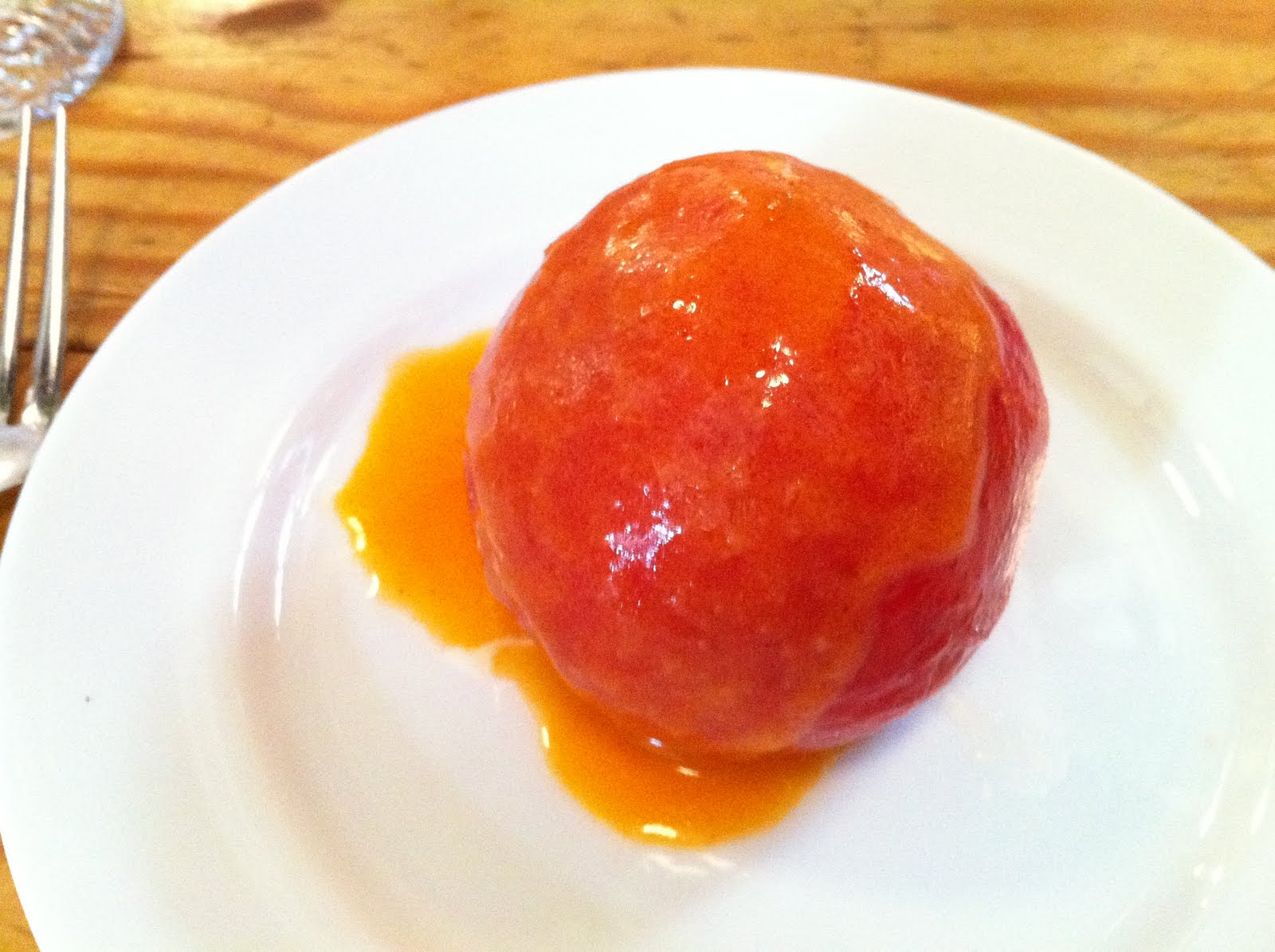
This is the tomato salad starter at Grill Tsubame in Ebisu, one of several restaurants on the 6th floor of the Atre mall above the JR station. The tomato is peeled (like a grape - unnecessary, but nice) and coated in ginger-carrot dressing. There is shredded daikon hiding underneath. Fancy fancy. Totally unexpected addition to, and the best part of, my straightforward grilled salmon with rice lunch special.
When we first moved here I thought I'd try to avoid eating in shopping malls but the truth is, when it's like Miami in August out there, and you're on your way to catch a train or just stepped off of one, these clean, spacious and air-conditioned dining halls can be very appealing.
Grill Tsubame
Tuesday, September 13, 2011
from The New York Times
By Martin Fackler
September 12, 2011
MINAMISANRIKU, Japan — Six months after Japan’s deadly earthquake and tsunami, the naked steel frame of the former Disaster Management Center stands like a tombstone over the flattened field of weed-covered debris that was once this town’s center. People come from near and far to pray before the three-story structure, turning it into a shrine of sorts for the town officials who died here.
Amid the white flowers, smoldering incense and bottles of beer and whiskey left to comfort the dead, there are also signs of rancor. A long handwritten letter, laminated to shed the rain, criticizes the failure to tear down the structure as callous disregard for the families of those who perished.
“This thing should be destroyed right away,” demands the letter, which is signed by the father of a victim.
The people of northeastern Japan won global admiration for their stoic dignity and communal spirit after the disaster on March 11, which ravaged hundreds of miles of coast and left more than 20,000 people dead or missing and hundreds of thousands homeless. But these days, that unity is fraying amid frustration in remote towns, like this one, that feel left behind.
In some of the tsunami-stricken areas, particularly the more prosperous regions closer to the city of Sendai, the removal of millions of tons of debris is progressing rapidly. Large improvised disposal facilities are grinding up broken concrete and wood into landfill material for reconstruction. But in the poorer fishing regions farther north along the mountainous coastline, many towns have barely finished the first basic tasks of survival.
Monday, September 12, 2011


Subscribe to:
Posts (Atom)