Wednesday, July 14, 2010

Monday, July 12, 2010

day out with Mizuho & Co.


Paid a visit to Hie shrine with Mizuho and her kids the other day. Hie shrines have been built and rebuilt since the 15th century, by various rulers seeking to enshrine their guardian deities. This particular one -- "constructed in the Gongen-Zukuri style with vermilion-lacquered finishings" -- was built in 1958 (replacing the previous Hie shrine which burned down during WWII, in 1945.) It's in Nagatacho 2-chome, west of the National Diet building, not far from the Imperial Palace.

The stairs we took back out to the main road (Sotobori ave., which separates Nagatacho from Akasaka, where Mizuho lives, and eventually runs into Roppongi dori) reminded me the Inari shrine outside Kyoto, the one famous for its 10,000 torii gates.

Hie shrine, July 2010
Inari shrine, December 2008

boy on a train

doing chores

sharp

Designer duds from Kiri No Hana
4-1-6 Roppongi, Minato-ku
www.poant-kirinohana.com
The shirts are one-offs, each a patchwork of old kimono fabrics, the designer told me, and they are half price. I don't know too many men who could pull of this look, aside from Rupert Rucker (below, rockin' a strawberry print). Mr. Rucker, you have until July 22 to snap one of these up! That's the day the shop closes (for the summer? for good? not sure..)

Toy Story 3!

Might be the best movie I've seen in years.

Thursday, July 8, 2010

Well Hello, Betty

Gaien-Nishi Dori, Jingumae

Pee Free

The boys are in all-day camp this week and next -- which is great, except for the fact that it brings me to Roppongi every morning and afternoon for drop off and pickup. Roppongi, except for the odd bright spots (Midtown, you get a pass, and Cavern Club, I still love ya), has got to be the most inconvenient, unpleasant, least pedestrian friendly part of town. But I was pleasantly surprised this morning to walk through an underground passageway -- the only way to get from one side of Roppongi to the other, at least where I was -- and NOT encounter a rank smell. It was positively odorless. The kind of tunnel that's supposed to be, almost by definition, urine-soaked and foul. Either nobody pees in public in Tokyo or city workers really scrub things down on a regular basis. Either way, I was impressed.

I still hate Roppongi though.

Except the movie theater at Roppongi Hills, of course.

Monday, July 5, 2010

a lovely gesture

We have new neighbors, a Japanese couple and their new baby girl, who looks to be about three weeks old. The wife rang our doorbell earlier this evening, said hello, gestured over to her own front door across the way and said something in Japanese, which I took to be along the lines of, we live over there now, and handed me a gift in a cute little 'Wa-Bi-Sa' shopping bag.

Accompanying her was the baby's grandmother, and she was carrying the little thing, with her black spiky hair, all swaddled in a pink blanket. Kawaii desu, I said (she's cute), thus giving the false impression that I could actually converse in Japanese. The women started chatting away and I shook my head and gave them my standard line, Nihongo sukoshi hanashimasu, gomen nasai (I only understand a little Japanese, so very sorry) but then managed to convey that I had futari otokonoko (two boys), and they were hachi-sai and kyu-sai (ages 8 and 9), and then I gave her our card with our names and phone numbers and she wrote their names and digits down on a scrap of paper for me. Hajimeimashite!

Inside the bag was a wrapped box; we removed the wrapping paper to reveal a box tied up with string; we untied the string, removed the lid on the box, and lifted the delicate layer of tissue paper to uncover six individually wrapped packages of "Kahoron" cookies, said to "combine finest European confectionery with Japanese ingredients." Here's a picture:
Oishii!

Thursday, July 1, 2010

Miraikan, robots and the Gadget Cat from the Future

The National Museum of Emerging Science and Innovation (Miraikan) out in Odaiba has an exhibit going on right now that begs the question: "Doraemon's magical gadgets -- can the current science and technology realize the dream?"

I think of Doraemon as the Winnie-the-Pooh of Japan, because he's this much beloved, ubiquitious illustrated character that started out as the star of a series of books (in D's case, manga) published a few decades back and is still going strong on TV, in movies, and as various forms of branded merchandise. I've posted about Doraemon before as my kids love the original series, which you can buy (translated into English) at Maruzen near Tokyo Station and Kinokuniya book store in Shinjuku and probably elsewhere...

Anyway, the exhibit. The museum website explains the objective: "We will introduce today's science and technology together with the world of dreams created by the magical gadgets such as the "Takecopter" and the "Invisible Cape." The exhibition can be enjoyed with the entire family and will teach you the importance of continuing to dream."

When we got in there, Terry wasn't too impressed -- he tells the kids that it's pointless to dream, because dreams don't come true (I'm kidding) -- but I kinda liked it and the kids loved it. Here's Dylan talking to some plants. "These plant-shaped robots predict the pauses of talk and nod accordingly"... They can't talk, but they nod as if they were saying 'I am listening to your conversation'..." a sign posted nearby explained.

And there's Conor comparing his height to that of the various robots whose inventors were apparently inspired in one way or another by Japan's Anime Ambassador. (Click here to read Lisa Katayama's post on boingboing.net that details Doraemon's best tricks.)
I recognized quite a few of the robots pictured (or even present) at the museum as I seem to have written about them all at one time or another, for Time mag's Best Inventions of the Year issue (back when I still freelanced for them... seems a lifetime ago). I seem to recall that most were designed to help the elderly or otherwise infirm. My favorite, though, was the crossing guard robot who had briefly managed the foot traffic outside a Tokyo elementary school. Reportedly, anyway. Someone had blogged about it or something. We put a stinger on the case (I was in New York at the time), but the article didn't run. I think it was because we couldn't get a good picture. That or the robot was a total gimmick (aren't they all?).

There are some really wacky robots here though. This is old news but I think this is one of the weirdest: Saya, the robot teacher. Read about the 18 motors hidden behind her latex face here.

I should look up old Saya, see if she's still standing in front of a blackboard somewhere...

Tuesday, June 29, 2010

Buono!

It doesn't surprise me at all that this year's 'king of pizza' is Japanese. I've had some of the best pizza of my life here in Tokyo. (And I'm a 3rd generation Italian-American from New York.) There's Partenope in Ebisu, for example. Outstanding. And Salvatore's, a ubiquitous chain, always excellent, even when home delivered! (I apologize, Joe of Four Corners in Pelham. So sorry, Mr. Fascati of Brooklyn. Get over yourself, Patsy Grimaldi. These guys do it just as well, if not better.)

Here's the story about the Nagoya pizzaiolo who won a recent chefs' contest in Naples, copied off the GVCI (for Gruppo Virtuale Cuochi Italiani, or Virtual Group of Italian Chefs) website:

Pasquale” Makishima triumphs at the International Championship of Pizzaiolo

The Japanese Akinari "Pasquale" Makishima was elected the miglior pizzaiolo (best pizza maker) of the 9th International Championship of Pizzaiuolo Naples-Caputo Trophy. Akinari, who has added ‘Pasquale’ to his name in honour of his maestro pizzaiolo, Pasquale Parziale of the Pizzeria Parziale on Corso Umberto, Naples, subjected himself to a competition lasting two days between 150 pizzaioli gathered together for the occasion of the ‘Vulcano Buono’ (‘Good Volcano’) of Nola near Naples. Second place went to the Neapolitan Vincenzo Caciali and third was won by Vincenzo Sandrico.

At the 8th International Championship, in 2009, Akinari already won third place and was nominated the Ambasciatore dei Pizzaioli Napoletani (Ambassador of Neapolitan Pizzaioli) to Japan. This year among those receiving the ‘title’ Ambasciatore della pizza napoletana nel mondo (Worldwide Ambassador of the Neapolitan Pizza) is Fabian Martin, an eccentric Spanish pizzaiolo from Livia, Gerona who, for the occasion of the Championship invented micro pizze-gelato, with mozzarella, parmigiano and gelato di pomodoro (yes, tomato ice-cream!).

For the organizers, presided by Sergio Miccù, who is responsible for the Associazione Pizzaioli Napoletani (Association of Neapolitan Pizzaioli), this Pizza Festival was “a true success in the number and quality of the participants.” From the Japanese delegation 20 pizzaioli arrived in Naples, along with seven French, five Spanish and ten American pizzaioli, among who was the many-time champion, Tony Gemignani.

“Ours is the only Italian championship that awards the pizzaiolo and not just the pizza – declared Carmine Caputo – because the difference is to be found in the skills of the person working beside the oven.” ...

Click here to read more.


Tuesday, June 22, 2010

eye exam

Conor had some very pink, puffy eyes this morning so I took him to an eye doctor, a Dr. Sumiya in Ebisu-minami. She spoke a little bit of English and with my meager Japanese we muddled through. She was great. She had a live video feed going so I could see a closeup of Conor's eyeballs, inflamed capillaries and all, on the TV screen next to his head. After a brief examination she declared the problem "allergic conjunctivitis" (not viral, not bacterial, and not contagious) and took a mini sport bottle and squirted some fluid into his eyes to flush them out, then added some drops and sent us on our way with a prescription for the same drops, which we had filled at a pharmacy around the corner.

Here's the prescription.

Multiple choice question: The doctor's personal style, whatever was visible under her white lab coat anyway, seemed on the conservative side -- white and navy striped sweater, creased navy trousers, pearl earrings, reading glasses on a gold chain -- but I couldn't help but notice that she was also sporting something that didn't quite fit the profile. Was it:

a) a toe ring
b) a butterfly tattoo on her ankle
c) fishnet stockings
d) motorcycle boots

Material Girl

I'm a very lucky girl, because I got to spend four days in Shanghai with some friends while Terry stayed home with the kids. Ordering a few shirts at the fabric market was one of the highlights. That's Brenda in the photo above, holding one of the samples at stall No. 357, the shop where I made my first purchase; the vendor, the guy I struck the deal with, is behind her wearing a gray shirt and fitting a different gray shirt onto another customer.

On the advice of other more experienced fabric market shoppers I had brought one of my own favorite shirts to be copied. But when I first walked into the building I was immediately overwhelmed. The place is a maze, the stalls are jam packed, there are bolts and bolts of fabrics, piled like giant logs or leaning against the wall, every spare inch of the place covered with samples on mannequins and hanging from the ceiling. There are just too many options -- you name it and you can have it custom made: suits, jackets, cashmere coats, cocktail dresses, dress shirts, slacks, skirts, tuxedos. When after maybe 20 minutes of wandering around I came upon this pile of linen you see in the picture and felt ready to do business. I liked the look of the fabric and the colors it came in. The vendor didn't pounce at first sight. I picked out a bright persimmon red and a lilac purple, showed the man my shirt, and the haggling started, with a calculator as communication device. He'd type in one amount, I'd type in another. I think he wanted 360 yuan for two and I managed to talk him down to 240 yuan, or around $34. After we had come to an agreement -- it took several minutes, during which the guy slowly and repeatedly shook his head, as if I was ruining his whole day, forcing him to take so little for his hard labor, a very effective tactic, at least on me -- I was given a receipt of pink tissue paper with "Shanghai South Bund Soft-Spinning Material Market" printed across the top, and the address of the building, No. 399 LujiaBang Rd., typed on the bottom, and the specifics of my order written in Kanji. He stapled his business card to it, which read Ji Bao Tian, as well as small snips of the material I had chosen, and I gave him a deposit. If I had lost this piece of paper, it's unlikely that I ever would've found my way back to him two days later to pay up and collect the goods.

Before fabric market fatigue drove me back out onto the street, where ladies were selling costume jewelry laid out on blankets and sheets spread all over the sidewalk, I managed to put in a second order, with Lucy from stall No. 219, for three sleeveless tops, all in the same style (another copy of something I already owned) but in three very different colors/patterns, in silk (or a convincing imitation of it), for 560 yuan, or about $80. In that transaction I totally buckled early.

Monday, June 21, 2010

delicious dish

It's not officially summer until we can get the cold sesame noodles with chicken and cucumber at the popular ramen joint down the road. I wish they had it on the menu year round.
Tukumo Ramen is on Komazawa dori next to Ebisu Prime Square, up the hill a bit from Shibuyabashi. There's always a queue around lunchtime.

Sunday, June 20, 2010

how does one become a member?

Office building somewhere in Setagaya-ku (I Googled "Glass Fairies Club" but got nowhere...)

purveyor of....?

storefront in Sangenjaya

Thursday, June 17, 2010

Dogashima

Friday, June 4, 2010

A few weeks ago the four of us spent the day in Dogashima, on the west coast of the Izu peninsula, on the Suruga Bay (not far from Shimoda, the beach town on the east coast, the Pacific Ocean side). There are some truly beautiful cliffs and sea caves there. The boys were even impressed...
To get there: first there's the 2.5-hr express train ride from Tokyo (JR Tokaido line from Shinagawa station, nonstop through Atami) to Shimoda station (station name is actually Izukyushimoda, important if you're sorting routes using Hyperdia.com). From there we hopped onto the No. 5 bus, which leaves twice an hour, I think, and takes about 50 minutes (you can buy tickets from a counter in the station), traveling along mountain roads, past rice paddies and through a few small villages, very scenic and surprisingly pleasant for a bus journey (the boys had water, snacks and their DS'es, of course, otherwise, I'd be singing a different tune I'm sure).

There's a causeway linking the mainland to one of the little offshore islands, and in low tide it's a bridge, and a place to find hermit crabs, etc. Sadly our timing was off for that, so we settled for a brief trail walk and the 20-min sightseeing cruise. Totally worth it, for the view and the thrill. One sea cave had a natural skylight, letting the sun shine in from overhead -- see last photo below..
If you've got a weekend in Shimoda already planned and can steal away for that extra day, go! We arrived in Dogashima around 2:30pm on the Friday and were still back in Shimoda in time for dinner.

Monday, June 7, 2010

weird ad

Somebody please explain this Winston campaign to me.

It just seems... counterintuitive. On many levels.

Friday, June 4, 2010

put on some tights and relax, boys

'Feminine' lessons offer men respite from stress
Kunihiko Miura
4 June 2010
Daily Yomiuri

Six men intensely arrange flowers in their class at Ikebana Sesshu-ryu on a mid-March weekday evening. Five of the men, in their 20s to 40s, are in business attire for the class, which started a year ago.

Kotaro Matsukawa, 30, who works at an insurance company, attends the class three times a month on his way home from work. "Flowers calm me down--at the office, I'm always on the phone or at my computer."

Recently, more and more men are attending cultural classes typically associated with women. According to Gishio Horiuchi, 48, lecturer at Koomon--a Nihonbashi, Tokyo, club that offers tea ceremony lessons, including introductory classes for men--about five dozen men are enrolled in the class, a 20 percent rise over the past two years. Horiuchi said the majority of them are white-collar workers.

Horiuchi said, "I think there are a lot more men now who want to develop their senses, rather than cling to economic values, in light of the current economy."

Another appealing aspect of these classes is their approachability.

Among the women in a ballet class in the basement of an office building near JR Akihabara Station, a number of men wearing tights and black ballet shoes pose clumsily as they try to raise their legs high into the air.

Men account for more than half of the 33 students at Ballesonance Tokyo Ballet Studio, which opened last June.

The school has a supply of large ballet slippers, as well as deodorant for the men, to make it a more pleasant atmosphere for the women in the class.

Ballet is growing in popularity among men, prompting the school to add another class in Meguro Ward, starting April 2.

Hospital worker Tatsuya Yamamoto, 30, said: "It's refreshing to move my body to beautiful melodies; it's good for working off my stress from work."


Thursday, June 3, 2010

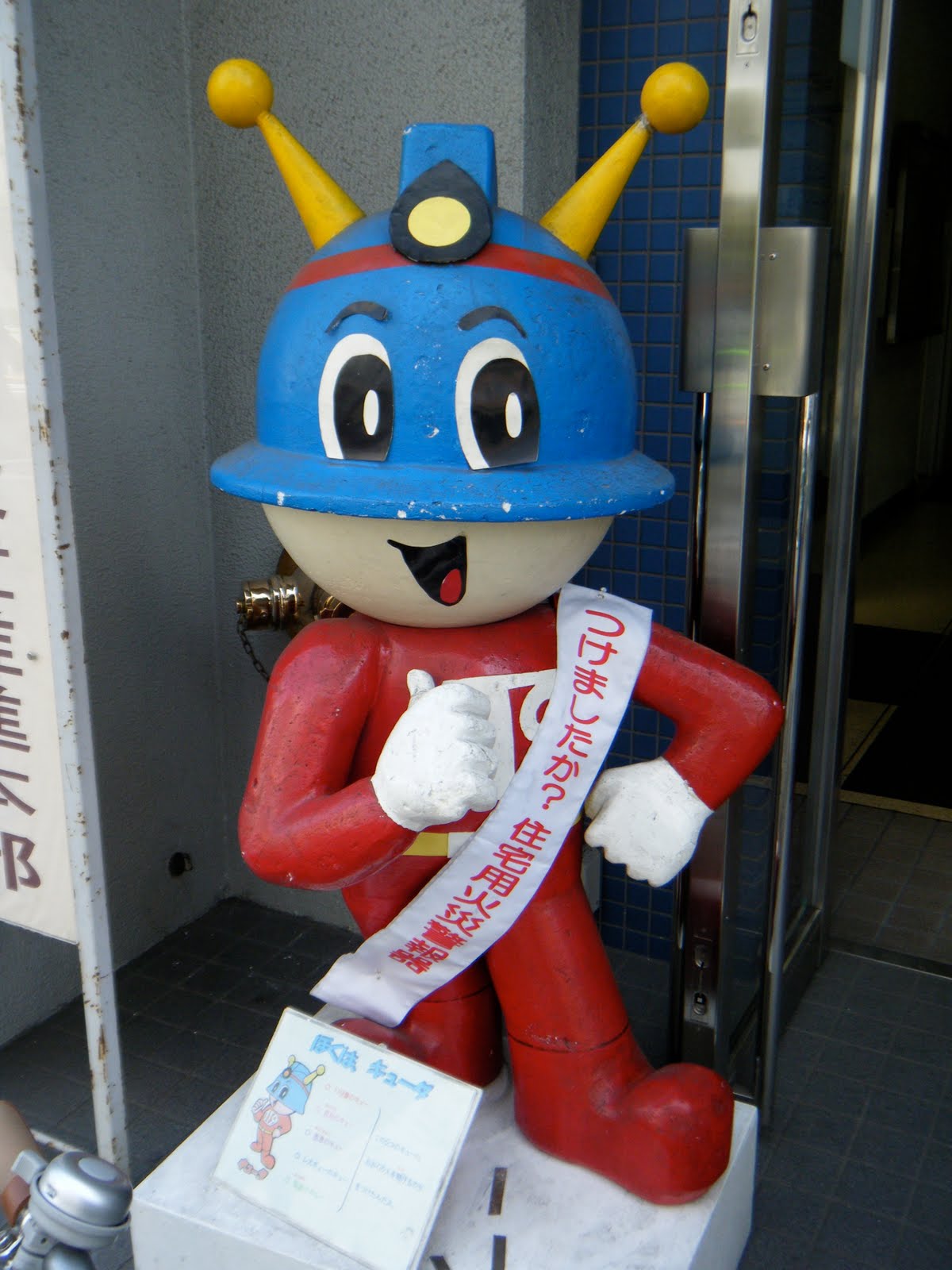
Azabu Fire Station mascot

I did not know this

Apparently those who work for the Keihin Kyuko line (electric train service from Tokyo to Yokohama, Kawasaki and other destinations) are subjected to a morning "smile check." Read about it here

Wednesday, June 2, 2010

space invader in Nishi Azabu!

Mickey Mouse is your super star.

Or so says this handy shopping bag, available in a Kappabashi shop that Brenda and I wandered into yesterday...

Saturday, May 29, 2010

girls' nite out

Finally, a red-light district moment.

To celebrate a friend's birthday the other night, a bunch of us went to 13 Street, a club in Kabukicho.

Three words: male pole dancer.

The 40-min show at this "Mens Dance Show Restaurant" featured 7 or 8 of these performers -- all well-groomed, trim and toned, and, we assumed, gay -- kicking it on stage like they were on Madonna's Blond Ambition tour (the choreography! the costume changes!)

Did I mention the pole dancer?

I've never been to a male strip club even in the States and had assumed the guys would be taking it off, but it wasn't that kind of place. (A little disappointed, mainly relieved.) We did see one nipple (thanks to a loosened kimono) and one bare butt (robe dropped to the floor, lights out, and, Scene!). Oh wait, three nipples if you count the pole dancer, who wasn't wearing a shirt. He was quite something. A real gymnast.

Our group sat in the front row, side by side on a red leather banquette, a foot or two from the stage, and before the show some of the dancers came over to chat us up while a waitress served us drinks and lovely plates of chicken, rice and salad.

Then the music went up, the lights went down and we Western women started clapping and cheering (as you do in these situations) until somebody noticed the other patrons were just sitting quietly sipping their drinks. Were we in bad form? Probably. Typical gaijin. But we carried on, and at the end, the guys feted our birthday girl on stage, so there you go.

Love microphone guy's sandals and leggings.

13 Street is at 1-12-9 Shinjuku, 4th Floor. Apparently "Love Wagon" is right upstairs...

Wonder what the talent is in this Pub...

Friday, May 28, 2010

the rough life of a Japanese royal

Oh, to be the mother of the rough third-grade boys who frightened poor Princess Aiko! (See below). I've heard that we have a few Japanese VIPs at our school; apparently they like the anonymity, as most expats, myself included, are oblivious to their fame and status.

Anyway, I just thought this was an interesting article, which I read in today's IHT (it appeared in the NYTs yesterday).

May 27, 2010

Imperial Adjustments

TOKYO — The drizzly weather didn’t dampen the excitement at the annual spring imperial party last month as the royal family strolled along Tokyo’s Akasaka Palace grounds. Mao Asada, the Olympic figure skating silver medalist, was so overwhelmed when Emperor Akihito spoke to her that she managed only to repeatedly reply “yes,” and “thank you very much.”

It was a typical reaction that shows the magnetic hold the emperor and empress have over the Japanese people.

Missing as usual from the festivities was Crown Princess Masako who suffers from a stress-related disorder that causes anxiety and distress and only occasionally attends official functions. On that day, however, she was caught up in another issue compounding her personal difficulties. Princess Masako was with her eight-year-old daughter at school, encouraging the young princess who is struggling to overcome absenteeism.

Princess Aiko, who is in the third grade at an exclusive, private school traditionally associated with the imperial family, became reluctant to attend class in early March after she was frightened by the rough behavior of some boys, according to palace officials. Since then, in a worrisome situation of the vulnerable leading the fragile, Princess Masako began accompanying her daughter to school every day, with the two of them returning home after just a few hours there.

As a woman from the same generation, I have sympathy and empathy for the 46-year-old crown princess. The Harvard-educated career diplomat lost her independence when she married Crown Prince Naruhito in 1993. She then spent years trying to bear a male heir. Eight years into the marriage, she produced Princess Aiko, who as a female cannot ascend the throne.

All the while, Princess Masako has been under intense public scrutiny as to whether she meets the standards of the tradition-bound imperial family. The Japanese royals don’t have any real political power, the post-World War II Constitution having stripped the emperor of his controversial wartime leadership. Today, the job of imperial family members is to attend official functions, which they do nearly every day, and to partake in religious rituals inside the palace.

These days the Japanese are increasingly questioning whether, when the time comes, Crown Prince Naruhito will be able to carry out the duties of the throne — ceremonial as they are — with the continued absence of his wife.

It’s hard to know much detail of goings-on inside the moat that surrounds the downtown Tokyo imperial grounds. Palace officials restrict their weekly briefings to a select group of journalists from the mainstream Japanese media who in turn tend to acquiesce to imperial requests on what not to write. After officials announced the bare bones of Princess Aiko’s problems, they asked the captive press to refrain from reporting on the school.

Palace doctors did provide an update on Princess Masako’s condition in early February, saying they had been treating her for more than five years for “adjustment disorder with mixed anxiety and depressed mood.” They emphasized that the princess was recovering well, but with her rare appearances it doesn’t seem that way to the public. Without more frequent and specific updates on her treatment and progress, interest and sympathy for the princess is in danger of fading.

That would be a shame because Princess Masako is in a unique position to be a source of comfort and support to the Japanese, especially women, because she can cast light on their struggles through her own experiences with them. A plummet in career, infertility and school problems are common issues among women and mothers here. Psychological disorders, long stigmatized, are only recently being openly discussed.

The princess also has the charisma to appeal to a wide audience. I remember how giddy with excitement the women I spoke to along the streets of her wedding carriage procession were, charmed by her radiant smile and pretty face. Her rare public statements are frank and touching. “I was overcome with a feeling of ‘Thank you so much for coming into this world,’” she said after the birth of Princess Aiko.

Due to the stress she feels from being in the limelight, Princess Masako hasn’t spoken to the public since a 2002 press conference. But hopefully we will hear more of her heartfelt remarks in the future. Until then, Empress Michiko, 75, will continue holding down the fort as imperial consort.

One morning late last month, the main street by my house was suddenly empty of traffic, and small crowds formed by the crosswalks where the pedestrian lights remained red. Empress Michiko was passing through town. As the motorcade rolled by, the empress delighted onlookers with a full view of her kind gaze, the window of her black sedan rolled down all the way. Empress Michiko nodded and smiled to passersby, looking beautiful and elegant, but with the soft creases in her face revealing a weariness of age.

Kumiko Makihara is a writer and translator living in Tokyo.

Thursday, May 27, 2010

Heiwa no Mori Koen obstacle course!

A paradise for active kids, this place. Absolutely brilliant: climbing frames, climbing ropes, ladders, zip lines, floating logs, and almost all of it under shade trees. One particularly challenging bit had us crawling through a rope tunnel that was practically a vertical loop-dee-loop.

This one tripped me up:
It was taking me so long to get through it that Gabrielle's 12-year-old daughter suggested I split my legs and leap rather than climb up and down. That, um, didn't work so well.

Whenever I had to scale a wall, I thought of that struggling navy cadet Casey Seeger (I just totally IMDB'ed that) in An Officer and a Gentleman. Where is Richard Gere to inspire me? I joked. None of the British mums knew what the heck I was talking about.

For those who want to go -- and I strongly recommend that you do -- I should say that we went during half term, on a Tuesday, and had the place to ourselves because Japanese schools were in session; I can imagine it being mobbed on weekends. Also, take note that there is a Heiwajima Park AND a "Heiwa no mori koen" marked on p. 74 of the bilingual Tokyo City Atlas I bring everywhere with me (and that I think every expat should have). These two parks are separated by a big road called Kannana dori (same name as the exit you take off the Shuto Expressway if you're driving there). The obstacle course is on the south side of the road, near the tennis courts, not far from the water (part of Tokyo Bay, or maybe a canal leading out to Tokyo Bay -- apparently there's a rocky beach worth exploring too). Click here to see a google map. There is a parking lot, but you can take the train too. The closest station is Heiwajima on the Keihin Kyuko line, 7 min. from Shinagawa, a major hub.

The kids (and you) should wear sturdy feet-hugging water shoes or sandals like Keens, something with good tread. Sneakers only get soggy; Crocs are terrible for climbing, or even running for that matter, and the course terrain is uneven, rocky, tree-rooty and muddy, though there are grassy bits too). Hide your food -- picnicking is against the rules and the maintenance man/rule enforcer does walk around checking the equipment (which is a good thing, I know). Bring lots of water or stock up at the entrance vending machine. Oh and don't forget Band-Aids and a change of clothes for each of you, including parents (we had some, ahem, adult mishaps on the raft that you "ride" across the pond, pulling yourself along via some low-hanging ropes. Let's just say Victoria was happy she didn't wear her white shorts.
Read more about Heiwa no mori koen and other Tokyo parks here.

Monday, May 24, 2010

relic from another time?

I had heard that Japan had beer vending machines but haven't really seen all that many. This one, outside a liquor store near Namiki bashi, on the Sakura-gaokacho side of Meiji dori (sort of hidden next to the northeast end of the bridge that takes you over the train tracks and into Daikanyama) seems to be out of order.
Maybe the other two are working. (Is that umeshu by the quart?)

Thursday, May 20, 2010

What is Life?

Even though I can't read the aisle cards, or any labels on any of the products, and have to rely on my power of sight (what looks like sliced ham is sliced ham, what looks like chicken legs are chicken legs, etc.) and memories of past purchases, I love, love LIFE supermarket on Meiji-dori. It's between Shibuya and Ebisu in the Higashi area (walking with Shibuya station behind you, cross Namiki bashi (if you turned right you'd head into Daikanyama) and it's a bit farther on your left; the sign is a big golden four-leaf clover on a red background, which you can't miss).
I come here for the unbeatable (as far as I know) price on the boys' favorite cereal (a shameful "choco" version of Cheerios that I bought the first week we moved here because I was worried they were traumatized and wanted to cheer them up with something I never ever would've allowed them to have before -- and now it's breakfast 4 out of 7 mornings a week).

I also come for the wasabi flavored rice crackers. Still haven't been able to find the amazing yuzu version of same..
miso paste

beer

Dylan makes a Fortune Cat

Behold Dylan's "Maneki neko," a.k.a. Beckoning cat, Lucky cat, or Fortune cat. It's the latest project to come out of his after-school Japanese Culture Club.

Spotted this one painted on the wall of a stairwell leading down to a restaurant near Center Gai in Shibuya. If I understand things correctly, when his right paw is up, it means "Good Luck;" left paw raised means "Welcome."